Showing posts with label tigress can jam. Show all posts

Monday, September 13, 2010

September Tigress Can Jam: Nectarine Jam

Thanks to Kate at Hip Girls Guide to Homemaking, we did not miss out on stone fruits this year of the Tigress' Can Jam! That's a big shout out to all fruits with pits, or stones, in them, like peaches, nectarines, plums, apricots and cherries.

It started like this: I had waaaayyy too many nectarines, and the last of them needed to be canned, stat. I sliced them all up and had them sitting around in sugar. With one batch, I made Nectarine Sauce with Noyaux Liqueur. Check out my inspiration, Pirate Peaches by Local Kitchen. I didn't use her procrastinaty method, but it's a good one. I merely macerated the fruit with sugar and boiled it up to my preferred consistency, added some liqueur at the end.

With the second batch, I made some straight up, super simple, Nectarine Jam. I've been really enjoying Hitchhiking to Heaven's recipe for Yellow and White Peach Jam, which I've used in various incarnations this summer.

I don't usually use commercial pectin, instead I like to rely on the fruit's natural pectin or pectin from an apple stock. But I'm not against ever using commercial pectin. Sometimes it's fun. And I understand why it was developed. It makes things super quick. Back in the day, some hard working women thanked their lucky stars for pectin. It cut down on fuel use and time (however, it did up the sugar). I had some Pomona's Universal Pectin hanging around, so I used the rest of it in this jam giving it the pectin boost it needed, nectarines being a low pectin fruit.

Have a go at nectarines. Many say they are peaches without the skin to remove, but I find they have some special charms of their own!

Nectarine Jam

3 pounds, pitted and sliced
2 cups of sugar

Combine the nectarines with the sugar and let them sit in the fridge for 6 to 8 hours.

Put this mixture in your jam pot and add:

1 tablespoon of lemon juice
2 teaspoons of calcium water

Bring to a boil. While it heats, crush the fruit with a potato masher, my fruit-crusher of choice. You can do what you want here, depending on your tastes. Let the mixture boil for about ten minutes.

Have ready and mixed in a small bowl:

2 teaspoons of sugar
2 teaspoons of powdered pectin*

Add this to the fruit. Cook for two minutes. Turn off the heat and ladle into hot half-pint jars. Process in a boiling water bath for ten minutes.

* Please note that this is for Pomona's Universal Pectin, which is not as complex as it may seem. They have lots of directions on the package, but mine differs slightly. You can buy this kind of pectin, which allows you to lower your sugar amounts, at health food stores or online.

Tuesday, August 17, 2010

Tomato Ketchup: August Can Jam

Okay, so this month's issue of the Tigress' Can Jam was all about tomatoes. How do I know? I picked it! So, along with my assorted eight tomato plants, I also bought fifty pounds of tomatoes from the nice folks who farm a few miles away from me. They were all heirlooms, and one case was "softs," and one was the good stuff. It was more tomatoes than I've ever purchased before, and I had quite a marathon. Especially since I had also purchased a case of peaches at the same time. Ahem. Can you say crazy person?

That, my friends, was a darned lot of blanching. I will also tell you this: instead of using a billion ice cubes for your water bath, why not use an ice pack? I did and it made things much easier. Especially if your water is running warm, just pop another one in. Ice is a pain.

There were a lot of things I made, and there are many things still left to make. Tomato preserves and tomatillo salsa are two of them. The chipmunks are eating all my husk tomatoes, so that's not happening. I made Fresh Vegetable Salsa from the Ball Complete Book of Home Preserving and Tomato Basil Sauce from Canning and Preserving with Ashley English. I also made a ton of ketchup. And I know a lot of people are making ketchup these days, and I say Kudos! Because it's a long, splattery road, but the rewards are well worth it.

That said, I had a plan to make it easier. And it's nothing no one's done before. But I'd like to toot it on a horn, because I like the idea so much. And it's this: use your crock pot! Or slow cooker! Whatever you call it, just use it. Because then you can just walk away from it while it sloooowly cooks. Or let it cook while you sleep. Even better. And can it up when you want. Just make sure it is fully heated up before you jar the goodness. As a two-year old friend of mine says, "Oh, my goody!"

I used two recipes, one was the Joy of Cooking's Tomato Ketchup recipe, using it for spice and flavoring, and Food In Jars' Slow Cooker Blueberry Butter for measurements and inspiration. I made two batches. The first one was just from JoC, and it was way too much for the pot to handle. It took almost a day to cook and still it is rather thin, but the flavor was just what I look for in a ketchup. I realized I needed to make a smaller batch (ten pints is a bit much, no?), and to make sure I drained it before pureeing it.

8 cups of peeled, drained and puréed tomatoes and one medium yellow onion, diced.
Basically, I blanched the tomatoes to remove the skins. Then I roughly chopped them and drained them in a sieve. Then I pureed them in the food processor. I chose not to food mill it, and the seeds stayed in. I thought this might keep some pectin in for thickness, and also, it was easier. The onions were left in a rough dice, as I intended to use the immersion blender on it in the end.

Into the crock pot on low for six hours. For the first hour, keep the lid on. After that, I propped it with a wooden spoon. The next time I will keep the lid off the entire cooking time. Tomatoes have so much water I do believe they can afford this step. However, as in FiJ's recipe for fruit butter, fruit might suffer.

Then add sugar and spice, take off the lid and put it on high.
2/3 cup of dark brown sugar
A few cloves of peeled garlic
A spice sack: cinnamon stick, bay leaf, black peppercorns, allspice berries, celery seed
1/2 cup cider vinegar
1 or 2 teaspoons of salt, to taste

I use these neat little packets that are made for tea for my spices

Taste it! Then can it!
Make sure the consistency seems right to you. Remove your spices. Use the immersion blender if you so desire. Then, having prepared for this step before hand, can it. That is, have your jars warmed and sterilized, fill them to 1/2 inch headspace, and process them in a boiling water bath for fifteen minutes. My yield was four pints, plus a little for the fridge.

Tuesday, July 27, 2010

To Tomato, With Love: Tigress' Can Jam August Pick


Dear Tomato,

You are the one. How can August be August without you? How could Tigress' Can Jam be complete without you? Isn't it amazing how far you've come—from a green or golden little-known fruit in South America to a many-colored phenomenon featured on people's plates the world over? People have called you some strange names, like "love apple" and "wolf peach," but you made it into your own genus, Lycopersicon esulentum, a while ago. It's amazing that people see you as a vegetable, but really you're a fruit, and if you want to get specific, you're classified as a berry! Quel scandale!


And speaking of scandal, I know there's been talk of your notoriety, being from the Nightshade Family and all. I didn't know that your leaves were slightly poisonous if eaten, and that you are toxic to dogs! But I won't hold that against you. I know you're not trying to be mean, you're just trying to protect yourself.


Thank goodness you can be canned! You know, in a hot water bath so we can enjoy you in the winter months when you are long gone? Like the fruit you really are, your acid levels are high enough to pass muster (I know you need a little bit of lemon juice to help you out, though). It makes me dreamy: tomato sauce, tomato juice, tomato paste, tomato salsa, hot sauce, ketchup, and just you—tomatoes—in a glass jar are a thing of beauty! And I won't forget when you get all fancy and jump into a jam or confit or something like that. You can really change gears from work horse to operatic diva.

This is why I am picking you to be the star of August's Can Jam. I know everybody loves you every which way. Plums, cherries, big beefsteaks, heirlooms, greens, reds, yellows, oranges, and for good measure, let's include your cousins, tomatillos and husk tomatoes! Summer just wouldn't be summer without you!

Love,
Julia

Husk Tomatoes

P.S. The Deets: Your recipe must be posted between Sunday, August 15 and Friday, August 20. The deadline is Friday at midnight. Tomatoes should be ready everywhere! If the major crop isn't in, think of this as a test run for when it does! Read up on your tomatoes and use approved recipes. There's a lot of great information out there!

Tomatillos

Tuesday, July 6, 2010

Meeting the Canjammers

Here is a vanilla pot de créme that I made entirely with cream. The recipe calls for milk or half and half. It was a special occasion, and it deserved all cream. That and the fact that I had a half-gallon of cream in the fridge. Shae from Hitchhiking to Heaven was coming to visit, and I needed something special for dessert that was gluten-free. I needn't have worried, for we tasted five different jams, and had brandied apricots and special local chocolate as well. And I was worried about dessert??

You should read about Shae and I met and became friends, even though she lives in Northern California and I live in upstate New York. We bonded through a recipe for clementine marmalade. It's a wonderful story that Shae captures perfectly.

Here are two of her blackberry mojito jams. Did you know that she won nine awards in the Marin County Fair? I covet her beautiful fruit masterpieces.

We also tasted two jams from the same recipe. Isn't amazing how different they are? When Doris and Jilly came to visit, she brought with her a gift of this Fig Lemon Lavender jam, and as she did she said, "You didn't make this, did you? Because I know someone did." I said no, but remembered that someone indeed had made the same jam. The next day when I met Sarah Hood from Toronto Tasting Notes, she handed me the same jam! What's wonderful, aside from getting great goods from great peeps, is that no two jams are the same, even if you are making them yourself from the same fruit, in the same kitchen. They are always different. These two were both gorgeous beauties in their own right.

The next day was spent meeting more good canning folk over at Thompson-Finch farms where the strawberries are organic and lush. Or were. They are all gone now. This was a few weeks ago. Here's my haul, that I got thanks to Shae. I could never pick this much while chasing around the little toddler.

And afterwards, Kate (Hip Girls Guide to Homemaking), Tigress (Tigress in a Jam and Pickle) and Shae, busted out some serious picnic under the shade tree for post-berry picking talk.

It was a gorgeous spread and an inspiring day. Tigress talks about it here. And Kate describes her day here. And Shae does here. How can you go wrong with like-minded folks, good food, and strawberry picking? I'm so glad I got the chance to meet everybody. It makes this online world so much more special. And it happens a lot more than you think!

I went home and made some strawberry ice cream. Amazingly, I didn't make strawberry jam immediately! I had plenty of cream. And plenty of strawberries. And there was nothing better to do than to sit with a bowl of fresh ice cream, and savor the days.

Thursday, June 24, 2010

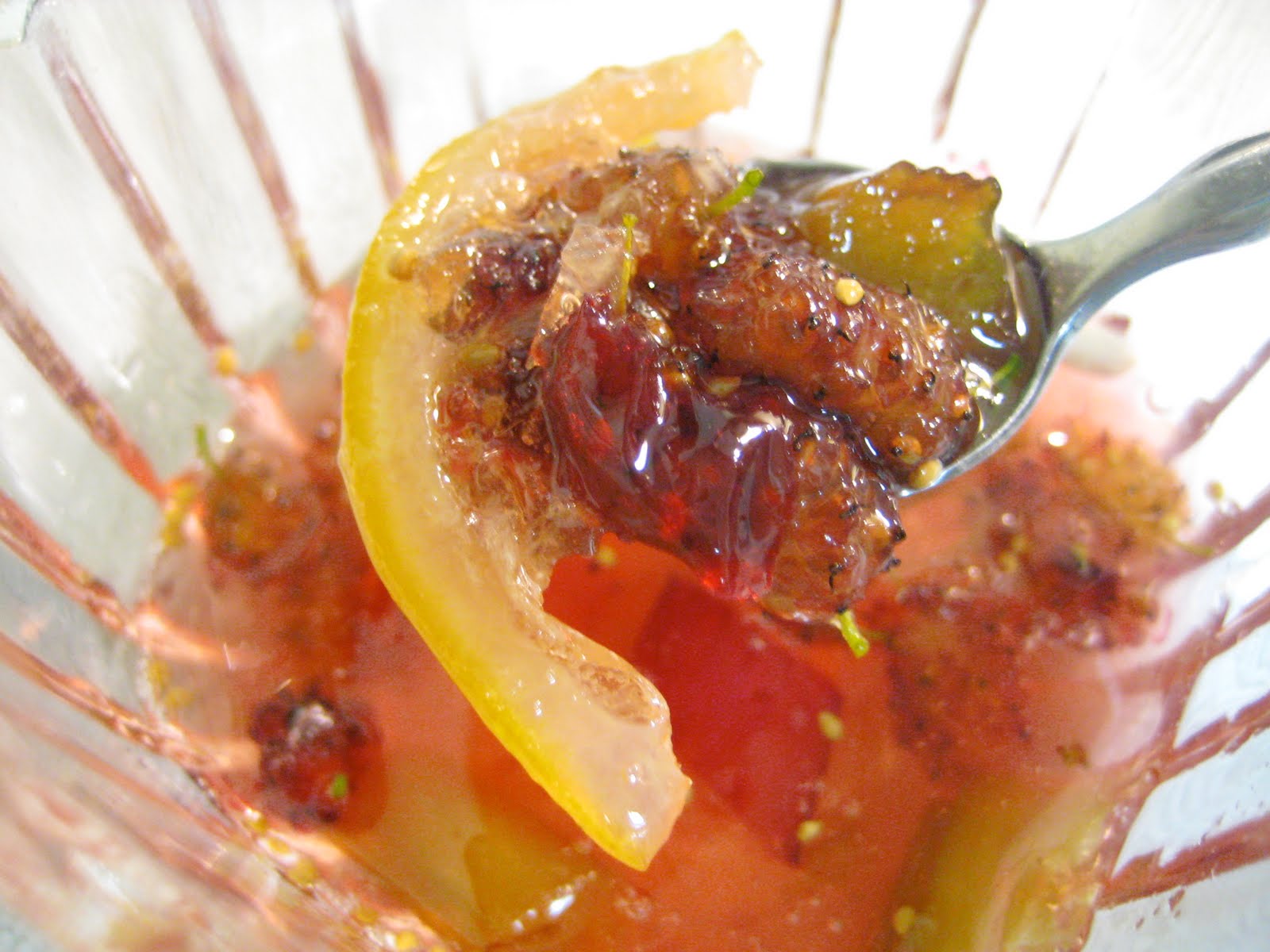
Mulberry Rhubarb Lemon Jam

For this month's installment of the Tigress Can Jam, the pick of the month, courtesy of the amazingly prolific and expansive Joel and Dana of Well Preserved, was berries. I can't wait for the round-up on this one. Who doesn't love berries? There are so many of them, and because this season has been incredibly early, we are rolling in them right about now. My strawberry patch stopped producing a while ago, and I thankfully caught the very end of the season at a local organic strawberry farm just the other day. I've gone across the Hudson river to pick black, red and pink currants, as my three highly productive bushes got completely cleaned out one day. (I think the culprit was a chipmunk and some birds. My fault I didn't have them netted.) Raspberries are everywhere in the wild, the small black variety and wineberries, a similar wild raspberry. The big red ones are right on their heels. And though elderberries are the size of a poppy seed, their flowers are everywhere and can make a nice syrup or liqueur. So. What do make?

A few years back, there was a small mulberry tree grappling for a space among a thatch of honeysuckle bushes. I cut back all the bushes and let the tree grow. Mulberry trees are the forgotten berry tree, even though they are everywhere and seedling pop up in cement cracks. I think people used to appreciate them more, but now they are considered just a nuisance. When I was a child, we had a large black-berried tree right next to the back door. We would spend a good portion of the summer in it. Mulberry trees are great for climbing, they have low limbs and many of them. My mother once told me a story about how mulberry tree leaves were what silk worms were fed in order to create silk. I promptly began eating the leaves, which are edible, and at the time, quite tasty. One day, my mother decided that she had had enough of the big, black berries staining the doorway, and it was cut down. I was a miserable teenager at the time, so I'm sure I pretended to not care or was outraged and indignant, one of the two---or perhaps both.

This year I was thrilled when the tree promised to have a good yield of berries. We have a white mulberry tree, which pales in comparison to the trees with black berries, both in color and taste. My son, who is almost two, and I would walk past the tree every day to let out the chickens and graze on the berries. They are mild and lack acidity, but they are sweet and free for the taking. They lasted about two weeks, and at the end they really plumped out and took on a pinkish hue. Then, suddenly the birds took over, and they declared the season over. I neglected to take a picture of them while they were hanging in the tree. Early in the morning, it's hard to remember the camera, which isn't so bad a thing really. But I now realize there isn't one good picture of the white mulberries. Can you see them floating around with the rhubarb and lemon down there in the pot?

This jam didn't gel up too much, just like my rhubarb jam from last month, but it's incredibly delicious. I think there was a bit too much sugar in it. The taste is sweet and yet still tart, and the texture is wonderful. Strands of chewy lemon, chunks of rhubarb, and mulberries all retained their shape and became candied.

2 cups of mulberries (don't worry about those little stems, you can eat them!)
1 cup of rhubarb, diced
1 medium lemon, sliced finely
3 cups of sugar

Boil in a heavy pot until gel stage is reached, usually at around 220 degrees if you are using a thermometer. Process in boiling water for ten minutes. Makes three half-pints.

A walk down the block finds many black-berried mulberry trees, and the other day when I was looking out for a particularly good branch I had found earlier, I spied, thankfully, a large black rat snake, hanging out in the branch. Do snakes eat mulberries? Or was it just a really nice hot spot? I didn't linger to ask.

Wednesday, May 19, 2010

Rhubarb Jam

If you have been reading the last few posts, you know that I have a little bit of a rhubarb problem. About twenty pounds of a rhubarb problem, actually. Lucky for me, this month's Tigress' Can Jam the chosen item is rhubarb, along with asparagus (which I ended up eating already!), picked by Sarah over at Toronto Tasting Notes. My biggest haul at once was just over 12 pounds from a local organic farm in Accord, NY. I admit, it was a little daunting once I starting working with it. Four pounds were chopped and immediately put in the freezer. Four more pounds were simmered, strained, with juice and the pulp frozen separately for later uses. Another four were used for this jam.

I haven't opened Mes Confitures since my winter obsession with it, and it was fun to dive back in, especially since there are so many rhubarb combinations. This recipe hooked me because of its execution. Over the summer a friend gave me a jar of incredible rhubarb ginger jam from Ethel's Kitchen in Martha's Vineyard. It was incredible; big chunks of rhubarb held their shape in a soft sea of stewed rhubarb. Whenever I have made rhubarb jam, it breaks down completely, and I've found that this technique is the way around that.


Now, if you are familiar with Christine Ferber's Mes Confitures you will know that it's often cryptic. And a lot of the recipes are incredibly sweet. This recipe is no different. What's cryptic is that there is no pectin in it: zero. Rhubarb doesn't have any natural pectin, there's no added pectin, and no apples or other high pectin fruit. I knew going in that I wouldn't get a jell at all, but in the future I think I will add pectin (for those who are interested, I would add Pomona's: 2 t of each calcium water and pectin). I'm not sure if this is a morning on your toast kind of confiture. It's really more of a confection than a spread. I would drizzle this on top of ice cream or a dessert. It's really a syrup with fruit suspended in it.

I used this incredibly thin, delicate, red rhubarb that I received from the generous Meghan Murphy, a journalist, who also runs the Hudson Valley Food Network (If you are local, this is a great site to join if you want to keep abreast of the farm to table scene. It's also a great resource if you are visiting the area!) I had posted on the site that I was looking for rhubarb, and she kindly found me some. The small diced chunks are a perfect texture; the maceration shrivels them and I find them, may I say it? Toothsome.

Rhubarb Jam adapted from Mes Confitures by Christine Ferber

2 3/4 pounds rhubarb (the recipe asks for 2 1/4 pounds net, but this is the amount I used)
3 cups sugar (recipe calls for 3 3/4 cups)
2 T lemon juice (recipe calls for 2 T)

Make a small dice with the rhubarb. Macerate with sugar and lemon over night in a ceramic bowl covered with parchment paper.

Strain the syrupy juice and bring it to a boil in a heavy pan. Bring it to 221 degrees on a candy thermometer. Add diced rhubarb. Return to a boil, mixing gently. Skim. (I didn't skim, and it did leave me with some foamy bubbles in the jam.) Continue cooking on high for five minutes, stirring. Put jam in hot jars and seal. Process for ten minutes, turn off the heat and let sit for five more minutes.

Note: Ferber does not water process so this processing time was my guess. I think it's fine, due to the high acid content in rhubarb, plus the lemon, but do be advised this is not a tested recipe for water bath canning.


So, now I have a few more pounds of rhubarb left, and the strawberries just started ripening. I'm blown away by how many I am getting. I picked a quart this morning, and that's with my son eating quite a bit. I'm sure there's going to be a good strawberry rhubarb jam recipe I can use from the Can Jam this month!

Sunday, March 14, 2010

Shallot Confiture

This month's Tigress' Can Jam focused on alliums, or the onion family, only one of the largest plant genera in the world. Yes, the world! Another great pick! There were a ton of recipes that called to me, more than I thought, but this one sang my name. I am so excited about this. Shallot Confiture. Lord, it's gorgeous. Steve was totally making fun of me. When I was pulled it from the boiling water, I was doing Rocky poses and kissing my biceps. I am a total dork. So what. Go ask that woman who wrote the article in Slate, she knows what a trendy loser I am! (I know I shouldn't give her more press, but whatever, I'm feeling punchy. I think it's funny that she owns Mes Confitures. Now who's calling who ridiculous? Okay, got that out of my system.)

So: is this ever going to look pretty on a shelf, all backlit, or what?? Shallot Confiture, let's just say it again, shall we? This was a four-day extravaganza of boiling and sitting and boiling and sitting. But that's all easy, really. In the end you have a bunch of translucent purplish-brown pods that have been infused with a spice-laden vinegar syrup. Vinegar syrup? How can you be so good? To be honest, I haven't really thought of how I'm going to eat this. This is no work horse chutney or every day jelly. This is something that deserves the spotlight. The suggestion is warm or cold, with meats. I'm thinking with a pork roast, or a salad even? On top of ice cream? I don't know, help me out. I'm a little star struck at the moment. The pictures do it no justice at all. (It's been gray and rainy for days.)

The recipe is from the surprisingly good book, The Everything Canning and Preserving Book by Patricia Telesco with Jeanne P. Maack. There are some really interesting recipes in here. To be honest, I was turned off by the title--too general, and boring--but I was wrong. There are some interesting ideas in there. The recipe itself was clear and concise. I made a micro-batch and split it by a third. I should have done the whole thing because it was time and effort, and I'd be happy just looking at more of it on the shelf. There's a lot of caraway in this, which I wasn't sure of. But it works. The spices are just magnificent: spicy and peppery, sweet and tart. What I kept on wondering was: who made this up and why for?? It seemed like it would be good in an ornate bowl on a Renaissance table filled with fruit, wine and large joints of meat.


Here is my small-batch and to the point recipe:

1 pound of shallots
1/2 cup pickling salt
2 3/4 cider vinegar
1 cup and 1 T sugar
1 cardamom pod
1/2 tsp lemon zest
A two inch piece of cinnamon
1/2 tsp dried chili pepper
1/2 tsp whole cloves
1 tsp black peppercorns
1/8 cup of caraway seeds

Day One: Peel shallots, leaving root end intact. Put in bowl, sprinkle with salt. Add water to cover, stirring to dissolve salt. Submerge shallots completely with a weighted plate. Cover with a towel, put in a cool place and let sit 24 hours.

Day Two: Drain and rinse shallots, and dry them with a towel. Put vinegar and sugar in a pot. Put all spices, except caraway, in a ball or cheesecloth and add to pot. Add caraway. Medium heat until sugar dissolves. Then bring to boil--and boil for ten minutes. Add shallots and simmer for fifteen. Remove pot from heat and let sit, covered, for 24 hours.

Day Three: Bring shallots slowly to a boil. Simmer for fifteen minutes. Remove from heat, cover and let sit another 24 hours.

Day Four: Slowly bring shallots to a boil again. Simmer until shallots are golden brown and translucent. (Mine stayed a little purple.) Discard spice ball. Place into sterilized jars. Remove air pockets. Process for ten minutes. Store in a cool, dark place for 2 to 3 months for flavors to develop. Kiss those guns.

Wednesday, February 17, 2010

Vietnamese Carrot and Daikon Pickle

For this month's Tigress' Can Jam the focus, as many of you know, was carrots. A perfect pick, I thought, especially for me because while I've always been curious about carrot recipes my preserving fancy gets overwhelmed by more immediately enticing items. The sturdy dependable carrot is always there and sadly gets overlooked. I always have carrots around. I use them in so many recipes. And thanks to clever root cellars and great winter markets, I got to purchase some beautiful, local carrots from Four Winds Farm in Gardiner (check out their seedling sale in May, if you're local).

I went the straight and narrow for this post, but who can ever can just one recipe for the month's pick? There are too many interesting and delicious recipes to try. I think my next endeavor will be a chutney. But for now, we have a most satisfying and simple recipe. I have made this as a fresh pickle from The Joy of Pickling by Linda Ziedrich. I didn't know it could be canned, and didn't find out until I was flipping through the Ball Complete Book of Home Preserving. It's key to bahn mi or perfect aside some nice Vietnamese pork chops.

The tweaking I did to this recipe was to halve it, add coriander instead of star anise, and add a sprinkling of turmeric because I thought it would impart a nice color. I also grated the vegetables instead of them being julienned, using a hand grater that makes a nice, long strand. The adapted version follows.

1 1/2 cups white vinegar
1 1/2 cups water
3/4 cups sugar
1 tsp. grated ginger
1 lb. carrots, peeled and grated
1 lb. daikon, peeled and grated
1 tsp. coriander seed
A sprinkling of turmeric- maybe an 1/8 of a teaspoon?

In a heavy-bottomed pan, combine vinegar, water, sugar and ginger. Bring to a boil over medium heat to dissolve sugar. Add carrot and daikon and stir for one minute. Add turmeric. Remove from heat.

Place 1/2 tsp. of coriander seed in the bottom of each hot jar. Pack hot vegetables in the jars within a generous 1/2 inch of top of jar. Ladle hot pickling liquid to cover vegetables, leaving 1/2 inch headspace. Remove air bubbles. Process in boiling water for ten minutes. This yielded two pint jars, firmly packed.