Sunday, October 23, 2011

Cutting a Quince


Can you believe a fruit fly got on my nice picture?

A week or two ago I went for a winding ride, which is always a pleasure this time of year. The clouds were high and puffy, and the sun perfectly warm, the breeze perfectly cool, and best of all, my son, now three years old, fell asleep as we drove. The nap is a rarity these days, but for the most part, it's still very welcome. You know when you are driving and you sort of think you know where you're going, but you couldn't say precisely the way you were going? I knew where I wanted to end up, but I was guessing at the turns I was taking. Well, all the turns I took got me to where I was going in a perfect sort of way, sort of the way you wish life went all the time. I pulled into the driveway that has a small sign saying, Locust Grove Fruit Farm. No one was there, and I was able to get out and take in the view of the Hudson, which stretched out below the fruit tree lined hill. 

I let a few minutes pass before I called the number to reach someone. They answer the phone like it's their home, which it is, and I say I'm down by the barn, to buy quinces. There's some confusion even though I've called ahead, as they're older and the cell phone doesn't have the best sound. "She wants to buy quinces!" I hear the woman say loudly, and I can tell the man, her husband, finally gets it, and says he'll be right there. I've talked to the whole family, but I've talked with her the most, and we've chatted about canning, mostly. "Most people don't want to talk about canning these days," she told me, wistfully, "but I hear it's changing."

I squint in the sun at all the trees around me. When he arrives a few slow minutes later, he leads me into the barn and is quite proud to show me his quinces. "Look at these. Amazing, aren't they?" he asks, and I agree. They are gorgeous, sweet-smelling quinces, covered with a bit of fuzz, half green, a bit of yellow shining through. "People don't realize how hard this all is," he says, waving his hand at the bins of apples and quinces. We talk some more, and he shows me some pears in the large cooler, and we agree we both like Bartletts better than Boscs. I notice a few pints of raspberries off to the side, and ask if there are any more. "Nope," he says, and when I ask to buy them, he says,"they're expensive." I take them anyway, as I never got enough of them this year.

He carries the forty-pound box out to my car, though it's probably not as easy as it once was. He gives me two Bartlett pears to eat. I give him a jar of jam for his wife. As I drive home, my son still sleeping, the smell of the quinces fills the slightly hot car. I think about the quince jam I'm going to make, the jelly, and of course, some membrillo. I think of how long those quince trees have been producing; the farm has been working since 1820! It makes me feel like I've got time in a box, sweet smelling time, and I'm going home to make it last even longer.


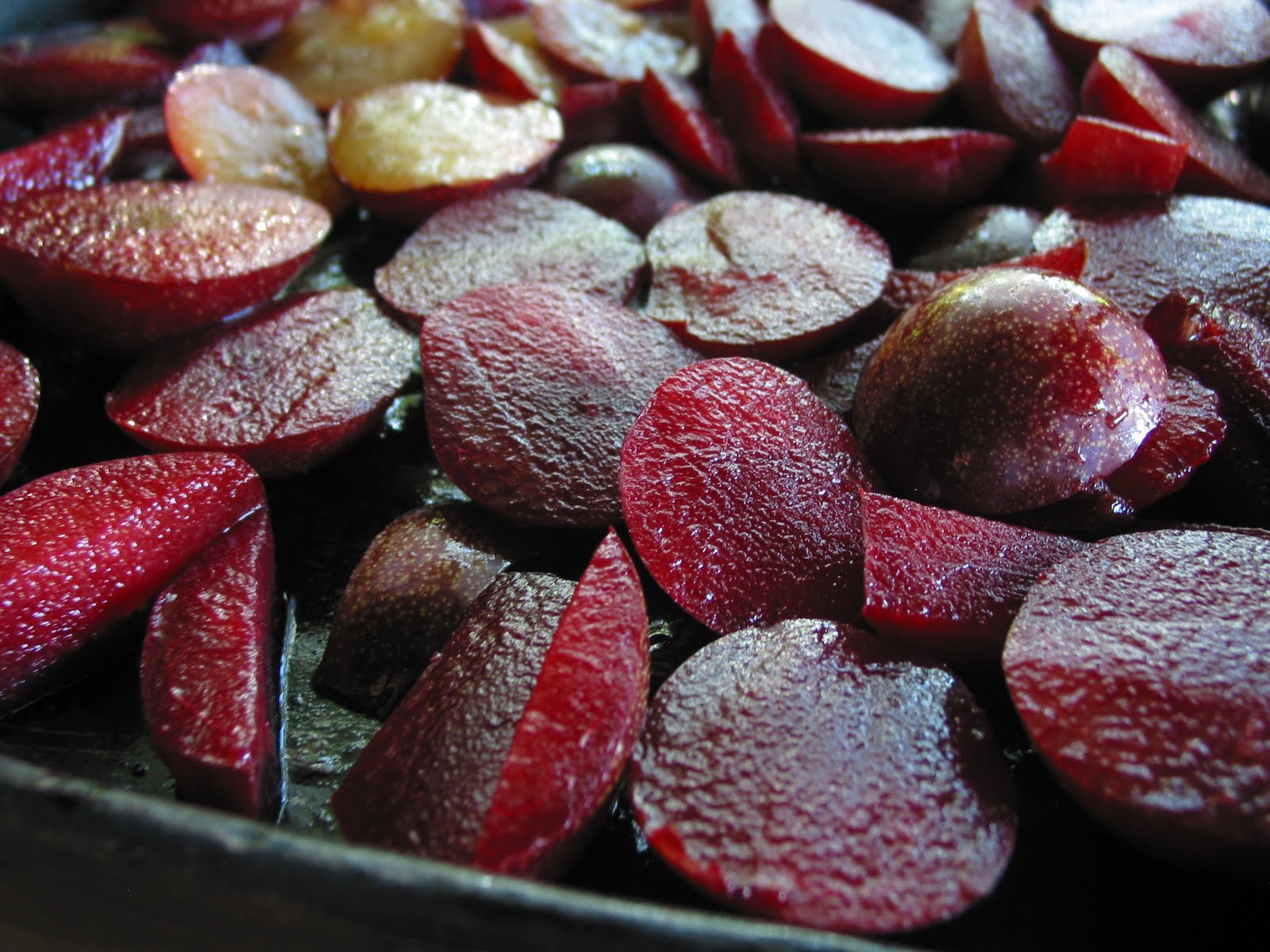
I know that lately there is a lot of interest in quinces, although some people never stopped being interested in them. One of the daunting things about quinces is that they are so hard, you sometimes wonder how to approach them. I've been chopping up quite a few of these, and this is how I do it. How much do you love quinces? What are you making with them? Leave a link, or recipe, or both!

Sunday, October 9, 2011

Autumn Musings and Lots of Apples


As I walk out of the house the past few mornings, along with a deep lungful of crisp air that smells like melting frost, I hear a lone cicada rasping its mating call. It's a beautifully strong sound, but filled with loss in that I know those final few clicks won't last long. The odds are stacked up against us, the cicada and me, autumn has arrived, and winter is not far off.

Please make some jam out of these Italian prune plums. You'll thank me later.
It's been a strange season ever since the storms Irene and Lee passed through. Aside from the obvious guillotined harvest season, there have been lots of bugs. Merciless mosquitoes, stink bugs aplenty, and now ticks are back in full force. Usually September is the month for festivals and fun, but it was dampened by continuous rain and bugs that kept you inside.  Now, we are noticing a late foliage season. Lots of my sugar maples, often bright yellow and gold, have already dropped their leaves, and those leaves were brown and crunchy from the seemingly endless rain. When I stop at farm stands, it's often the topic of conversation, and with it comes the inevitable long face for this is the season to make some money before the cold comes. People are jubilant that this weekend, touristy Columbus day weekend, is gorgeous. Thank goodness.

One of my favorite grapes: Niagara.
It's still been a busy season for me, making jam after jam after jam. Right now I am still slogging through a lot of apples (like 100 pounds a lot). This week I'll be getting a case of quinces, some concord grapes, and the thought of all this preserving just sends sort of a shiver through my mind. It's the fear of the onslaught, but of course it's exciting nonetheless, with its delicious ideas: conserves, jellies and preserves!

There is something about walking through an apple orchard...
The beginnings of my apples have yielded me applesauce, jelly and a new favorite, Caramel Apple Jam from Linda Ziedrich's Joy of Jams, Jellies, and Other Sweet Preserves. My favorite (read: easiest) way to get through a lot of apples is to quarter them, about six pounds at a time, and just barely cover them with water in a large stock pot. Bring them to a boil and let them simmer for about ten minutes. Drain them, reserving the juice for jelly. The cooked part gets put through a food mill, and becomes a jam, butter, or unsweetened applesauce.

If you are familiar with New Paltz, you can make out Mohonk in the distance.
I make sure to cut out the blossom end of the apple before quartering them, to ensure a good jelly. There's an enzyme in that part that inhibits the pectin's strength. To make this little annoying step go quicker, I've found that a teeny tiny melon baller does the trick. Melon ballers seem obscure, but I can't tell you how much they come in handy, and not just for that vodka-soaked watermelon ball boat. (Do you know what I'm talking about?) Regular sized ones are perfect for coring pears.

My teeny-tiny melon baller.

For tons of great info on cooking and preserving apples, take a look at these great links:

Preserving Apples from Local Kitchen (the most recent post of which is Apple Bourbon Butter!)


I'd love to hear what you are preserving this autumn. Leave a comment!

Friday, September 23, 2011

Canning Tomato Sauce with a Vitamix


Do you have a Vitamix? I just was gifted one, and it came at the perfect time: just when I was about to can 150 pounds of tomatoes. Tomato season is about done in my parts, so I could have said this earlier, but for future reference, if you have one of these splendiferous blenders you can cut your tomato saucing time in half. This is starting to sound like a commercial, but...No peeling! No straining!

I chopped my tomatoes into big chunks, and, as you can see below, they were huge. I did chop out some cores that seemed a big woody. Put them all in the blender, seeds, skins and all, and turn it on, quickly go from 1 to 10, and then to high, until all the seeds are gone, about a minute or less. Each batch gets tossed into a big stockpot on a low flame to heat, while you continue the process. Proceed with your usual tomato saucing/canning techniques.

That's how I canned 150 pounds of tomatoes this year by myself!


Thursday, September 15, 2011

Fine Liver Pâté

Out of the freezer for a photo op.

Well, this is the only picture I have at the moment, so it's not much of a seller, but I can assure you that this pâté will make you the belle of the ball. Maybe for ten minutes. To the one person who is eating it all. But that's okay. I'll take any recognition I can get. But seriously, can you puree something? Well then you can make some excellent pâté. The real question is: can you puree pork liver? Because, you know, some people think they can't. But you can!

I'll be honest, the blubbery mass that is the pig's liver is a bit slippery and a tad smelly, in a fresh liver kind of way. When I received my half of a pig, I had asked for all the organs and I received a huge liver. I think it was more than one liver. So, with two pounds of liver on my hands I made the easiest thing I could find, which was this recipe from The New York Times Cookbook, the original from 1961, edited by Craig Claiborne.

Because no one can eat that much pâté, I wondered and searched for a tip on freezing. And I found it from none other than Hugh Fearnley-Whittingstall (the tip is the very last sentence of the article!). The trick to freezing pâté is to freeze it before you cook it! Et voila. I did this, and that's why I have one pan waiting for the holidays. The other was unveiled at a friend's birthday party, surrounded by slices of pickled pears, and I can attest, as well as one other party attendee, that it was superb.

Fine Liver Pâté
Adapted from The NYT Cook Book

2 pounds of pork liver, cubed
3 eggs
1/3 cup of pear brandy (or cognac)
1 cup of heavy cream
2/3 cup fresh pork fat
1 onion, chopped
1/2 cup flour
5 teaspoons of salt
1 teaspoon of ground ginger
2 teaspoons of fresh ground pepper (I like it coarsely ground, with some sprinkled on top for appearances)

Use some rendered fat to grease two bread pans well. I used ceramic loaf pans. Purée the liver, eggs, brandy and cream. Add the flour, onion and fat a little at a time. It will be quite a lot of pinkish liquid meat. Pour into a bowl and add the seasonings, mix well. Pour into your pan and cover with plastic wrap, so that the wrap clings to the purée. Then cover well with aluminum. Freeze on a level shelf.

When you want to cook it, pull it a good day before you want to cook it. Put it in the fridge and let it thaw slowly. Once fully defrosted pull off the aluminum so you can remove the plastic wrap. Put the aluminum foil back on. Bake in a pan of water in a 325 degree oven for about two hours. There's no toothpick method here, you just have to know what your looking for. I pulled mine when the edges were pulling from the sides and getting dark. Serve on a platter with pickled pears.

This post is for the ninth installment of Charcutepalooza!


Love my CorningWare!

Wednesday, September 7, 2011

A Port in Every Plum Jam


A lot has happened in the last two weeks! Or is it now three? An earthquake followed by a tropical storm, days of power out, major flooding, and now, more rain. It felt like we lost a week with the storm---preparing for it and then getting back to normal. We were left relatively unscathed. I didn't have to kayak to my house, or get my belongings sucked down a river, or see months of tough farming that was just about to pay off get doused in the fires of flooding, like some friends did. The pond was overflowing, many roads were closed, and the neighborhood had a house burn down. Pumpkins bobbed in the nearby Hudson river, a sign of the fields lost to the flooding. We lost our power for only three days, and thankfully our generator kept the chest freezer, which was packed to the gills, nice and cold.

Our street, our stream.
While the power was out, I had a bunch of garden tomatoes waiting to be salsa. Thank goodness I had just finished 150 pounds of tomato sauce the two weeks before. There were also four pounds of black plums macerating in the fridge. And boy, did they macerate. They sat for five days! I was waiting for the storm to pass, then for the power to go back on, then finally, once we got the fridge on the generator, I opened it up to pull the plums. That day I made the jam. That night the power came back on. Figures. I do have a gas stove, so there was no worries there---it was just the lack of water that was stopping me, both for cleaning and canning. Ends up, I never had to go borrow water.

How are you doing? I hope that if you weathered the storm, that you didn't sustain too much damage!

Thank you, Coleman lamp.


A Port in Every Plum Jam

4 pounds of black plums, halved and pits removed
1 1/2 pounds of sugar

Combine and let macerate in a turned off fridge for a few days! Without the storm, I would've let them macerate a day or two in the fridge. But maceration is the boon of the preserver. It always buys you time. These firm plums probably stood up to the sugar bath better than most fruit, though.

Pull the plum mixture and put in your jamming pot. Add:

1 pound of sugar
2 tablespoons of lemon juice

Bring the mixture to a boil, and let it cook at a boil until it reaches the gel stage, or 220 degrees on a candy thermometer. This will take about twenty minutes from the time it starts to boil. When the gel stage has been reached, turn off the heat and add:

two hearty glugs of port wine
a few coarse grinds of fresh black pepper

Stir to combine. Ladle into hot jars and process in a boiling water bath for ten minutes.

Cream cheese pastries.
These cream cheese wafers? cookies? pastries? are super easy to make. I used a 1/2 stick of butter and 6 ounces of cream cheese, pulsing them in the food processor with a quarter teaspoon of salt and a cup of flour, until they were thoroughly combined and looked like coarse gravel. Dumped into a bowl, you can then form the dough with a few kneads of your hands. Let the dough chill for an hour (or a few days, like I did). Roll and cut out circles. I egg washed and topped them with sesame seeds. Bake them for 8 to 10 minutes at 400 degrees. Make sure to let them cool well. If you eat them immediately they won't be quite as good---believe me! But do make sure to eat them up right within a day or two. They don't age well. This makes about twenty wafers.