Showing posts with label orange. Show all posts

Thursday, February 23, 2012

Double Batch Navel Orange Marmalade


Well, I did it. I finally made some marmalade. You see, last year I went a little overboard with the citrus, and I still have it hanging around even though I try determinedly to use it up. So, this year I disallowed myself shipments of expensive fruit, and instead enjoyed some calamondins sent to me from my mother. She also sent me some Florida sour oranges, which I haven't gotten around to using yet. But the other day I saw a pretty bag of organic navel oranges at the store and my compulsions got the better of me. That four pounds of fruit yielded almost a case of marmalade, and that's plenty for my household, including gift giving. 

This recipe is pretty easy, even though it takes three days. I'm not going to say I'm a marmalade expert; go visit Hitchhiking to Heaven for that. This is a homey kind of marmalade. I always used to be scared of doing two batches at once, but it's really very easy. What's nicest about it is that you can have two different flavors. I had been eyeing this King's Ginger liqueur for a while for a marmalade, and who isn't a sucker for a creamsicle?

Double Batch Navel Orange Marmalade
(yields about 10-12 eight-ounce jars)

Day One:

4 pounds of organic navel oranges, gently scrubbed and rinsed

The oranges should be in the fridge, maybe overnight, so that when you work with them they are chilled. I use my food processor for slicing the oranges.  Although many may scorn my callous handling of the mighty orange, it's a technique not to be overlooked. I do believe hand cutting is superior, but the food processor takes no time at all, and is uniformly thin. In the case of navels, or clementines, which generally don't have seeds, it's quite helpful. With seedy fruit, you can halve them, remove the seeds, and then slice. I like to cut off the ends, quarter the fruit vertically, and neatly process them "standing up" so that the orange slices are (for the most part) perfect pie shapes.

Put the slices in a large ceramic bowl, and cover with water. I used 7 cups of water. You want to fruit to be comfortable to swim around. I used a bit less than normal, because I like a firmer marmalade. Let the mixture sit over night, not refrigerated, with a piece of wax paper over it.

Day Two:

The next day, put the oranges and water in your jam pot, bring to a simmer until the peel is soft. Mine took no time at all. Put it back in the bowl (or leave it in the pot if you prefer) and cover, leaving again until the next day.

Day Three:


Divide the mixture into two different batches. Don't make it one batch, you'll be bummed because it'll take forever. Really, it's not recommended. Mine yielded two batches of orange slices and water that were six cups each.

Add 4 cups of sugar to each batch. For my two batches this is what I added:

The King's Ginger Marm: 


2 tablespoons of lemon juice
1 teaspoon of peeled, grated ginger
1/4 cup of The King's Ginger Liqueur (not to be added until the very end)

Creamsicle Marmalade:


2 tablespoons of lemon juice
1 tablespoon of vanilla extract (though I'm sure a vanilla bean would be exemplary--I didn't have any on hand)

Bring each mixture to a boil and let it cook for about 30 to 40 minutes, which depends on everything from the weather, your preferred brand of sugar or to the pot you used. I like a firm marmalade, so I let it go to the sheeting stage, but you may want to pull it earlier. I like to add my booze just as the gel stage is reached. I pour it in, turn off the heat, and gently stir while it simmers down.

Ladle into eight ounce jars, and process for ten minutes in a boiling water bath.

An antique Fire King sugar bowl is my refrigerator jam pot.

Sunday, March 20, 2011

Triple Sec


The world of orange-flavored liqueurs is a big one. Let's get a few things straight at the start. Triple Sec is orange liqueur usually made from dried bitter and sweet orange peels and grain alcohol. There are many different brands of triple sec, like Cointreau and Grand Marnier. Cointreau is apparently brandy-based, though a trip to their purple-prosed site reveals nothing but very funny copy.  Grand Marnier is a cognac-based orange liqueur. I'm sure I've had my fair share of "well" orange liqueurs, like De Kuypers and Marie Brizard, but I think I've stayed clear of Curaçao, that crazy blue stuff.

A while back I was sent some sour oranges from my mother in Florida and being fairly marmaladed out, I decided to make some booze. I had brandy in the house so I decided to go with it. I guess this is a Cointreau-style triple sec? There were a few recipes I sifted through, but what I was most intrigued by was a technique to bake orange slices at a low temperature first and then to soak the slices.

Preheat oven to 200 degrees

4 large sour oranges, sliced 1/8"

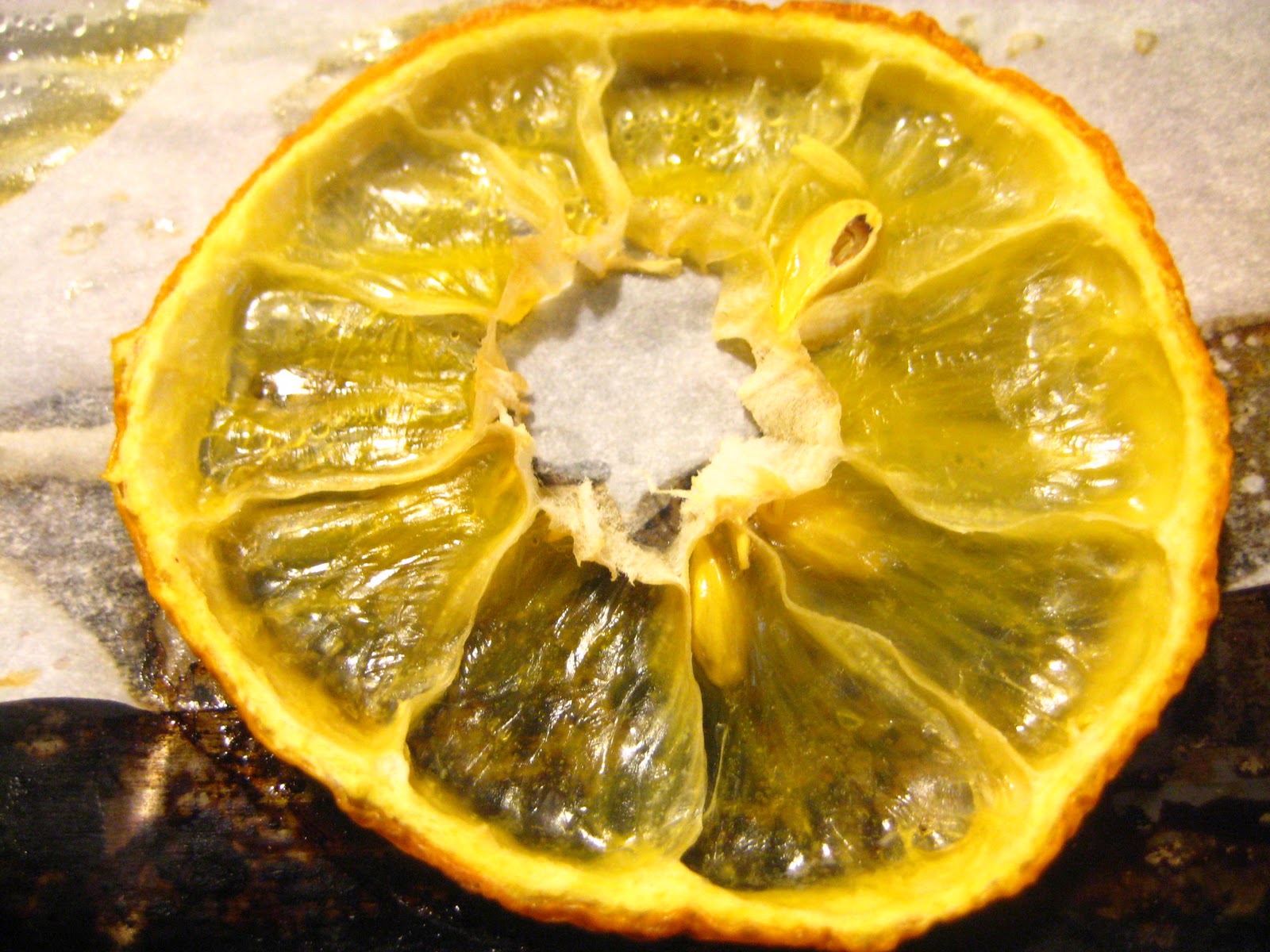
Arrange the slices on a cookie tray lined with parchment paper in a single layer. Bake them for two hours and then leave them in the warm oven. Doing this step at night works well--leave them overnight in the oven. Place citrus slices in a quart jar, cover with brandy and let sit for four weeks. Then strain the fruit, leaving the brandy in the jar. Add one cup of sugar and let sit for two more weeks, inverting jar daily until sugar is dissolved.

Note: I froze my brandy soaked citrus, thinking it might be a lovely addition to a marmalade whenever I get the impetus to make marmalade again.

I didn't add a simple syrup to the brandy because I wanted to really taste the oranges. As I'm writing this, I'm sipping a small glass. It's not as sweet as triple sec (though I must admit, I haven't had a straight slug of triple sec since I was what, 13?), and the taste of oranges first, followed by a bitter tang afterwards is very pleasurable. I now know why this was at one time a digestif, or aperitif.

Check out these other recipes:
Mrs. Wheelbarrow's version with Cara Cara oranges and vodka
An interesting version from Thursday Happy Hour that "tastes like orange hard candy"
and one from Food, Literature, Philosophy

Roasted. About to be soaked in brandy.

Friday, April 9, 2010

Apricot Plum Jam with Orange Pectin

Before full-on pantry raiding happens, the big freezer clean-out must occur. That is to say, that all the goodies in the freezer have to be canned or eaten. Particularly before a shipment of forty pounds of local chicken meat comes to roost. I'm a bit of a hoarder, so I still had two big bags of apricots and plums from last fall. Instead of doing small batches, I took them out in one fell swoop by combining the two. I feel that apricots and plums go incredibly well together. And because I had a jar of orange pectin in the freezer too, I figured I'd make the jam with that.

Apricots don't have much by way of pectin, but they have a nice level of acidity. Plums vary on pectin, and I've read a lot of varying reports on that. I think it's safe to say that if you have a sweet plum, say the black ones, you don't have a lot of pectin. I was working with a tart but sweet Santa Rosa, which are just a gorgeous pinky-peach color. I didn't want the orange pectin to overpower the flavor of the fruit, so I used much less than the ratio of the jelly I made with orange pectin, hence, it wasn't as firm.

This jam took forever to jell. It was sheeting like mad, however, not quite at the wrinkle stage, but I pulled it because it seemed to be overcooking and the flavor was changing from that fresh fruit stage to a more sugared fruit stage. After sitting, it still is a soft set but holds together nicely on toast. It's a real soft spread, as they say. It's a gorgeous carnelian color, and although sweet--even though the sugar ratio is quite low--it retained its punchy acidity, thanks to the fruit.

I thought about these measurements for a while and I'm still not entirely sure of them. I didn't add lemon juice, because the pectin has a bunch in it. I think if you are looking for a firmer set, you might want to have equal amounts pectin to fruit, so I should have had eight cups. That would have been too much for my pot. Next time I might make a much smaller batch.

4 cups plums, halved and drupe removed
4 cups apricots, halved and, or you can say, pits removed
4 cups of sugar
2 cups of orange pectin

Bring all to a boil. How long it will take? Who knows. I pulled this at about 219 degrees? I leave that up to you, mon frere. Process in hot jars for ten minutes.

Friday, March 26, 2010

Strawberry and Orange Pectin Jelly

Awhile back, during the citrus craze of winter, I became obsessed with the pectin found naturally in citrus. I then recalled the fall and its concurrent obsession with the pectin content in apples, and how one can utilize that pectin to make jams and jellies set instead of purchased pectin. I wondered if a person can do the same with citrus. Of course, I realized that apples are the perfect vehicle for pectin, in that they won't overpower the other fruit or fruits you want to work with. It's a very friendly fruit and goes with a bunch of other equally friendly fruits. Citrus is a little bolder, to say the least, and wants the spotlight. Or at least to get a stand out supporting role. And there's the bitterness. But still, I was curious.

I soon found this gem of a recipe that uses the white pith to make a pectin stock. I dutifully began to save all the white bits of any citrus I used. This I dub "stem to blossom end" jelly-making, in a nod to the snout to tail ethos of cooking. I saved pits, some peels and ends, and every time I juiced a citrus I would scrape off the innards and save the peels for candying, depositing the white parts to the freezer bag of pith. Pithy? Indeed. Pity? Non! Quite the contrary. I felt very resourceful, and, in using the whole fruit, I felt I was appreciating it's whole being.

Finally, the other day, I forced myself to take stock of the freezer and use up the stuff I'd been hoarding. Number one on the list was the bag of citrus bits. A whopping 2 1/2 pounds had been culled! The recipes I was looking at asked for a bit less, so I upped the numbers and hoped for the best. Here's the online version that I found on a page of GardenWeb's harvest forum, a great place for interesting info if you can stand your eyes bleeding from scanning through all the comments.

Recipe adapted slightly. This yielded four cups of liquid. I froze two cups and used the other two in the following jelly recipe, also found on the above link.

2 1/2 pounds of white pith of citrus fruits
1 cup lemon juice
9 cups of water

Chop up all the pith in a processor, so they are uniformly pea-sized. Add liquids to pith in a pot (I'll let that joke pass by) and let sit overnight. In the morning bring it all to a boil. Let boil ten minutes. Cool and strain. The directions say you may process it for ten minutes, or freeze. I chose to freeze half and use the rest in this jelly. (Note the recipe is from 1931. I don't think processing is a problem, but that's me, and I'm no pro. Just so we're clear on that.)

Strawberry and Orange Pectin Jelly

2 cups orange pectin
2 cups strawberry puree
2 cups sugar

Boil until jelling stage of 220 degrees. Ladle into hot jars and seal. Process in boiling water bath for ten minutes. (Again, on processing, I opted to do so, but this is a recipe from 1931.)

I will admit that I used some inferior, store-bought strawberry puree to use in this recipe. I didn't want wait for strawberry season, and didn't want to spend much in case this was a bust. The puree had "natural flavorings" in it, so the strawberry scent was pretty intense, and therefore stood strong against the orange pectin. There's a definite orange taste to the jelly, and a slight but noticeable bitter bite. But it's not overpowering at all. The set is firm and jammy, and it's not crystal clear even though I strained the pectin twice. The puree was dark and opaque, admittedly. I wonder if I stuck to pith only, or left out the pits, or peels, what the outcome would be. I also wonder how it would work with other fruits. There's a bunch of experiments here, ripe for the taking, if you'll pardon me, and I think it would be worth your while if 1.) you had access to great local citrus or 2.) you do a lot of supreming of citrus fruit. I qualify for neither, at least until next winter, but if you try this, or have done so already, let me know how it comes out (or came out). And make it pithy, would you?

Sunday, March 7, 2010

Marm: Orange Fig and Orange Earl Grey

Well, we all have our problems, don't we? Mine is marmalades. Can't get them out of my kitchen. I guess I've had worse problems in prior days. Making preserves is keeping me off the streets. Keeping me honest. Keeping me real.

Okay, so enough of that. I have been doing micro batches, and it's been so much fun. Check it:

I had four cups of peels and pulp that I brought to a boil with two tablespoonfuls of lemon juice and then let cool overnight in the fridge. The next afternoon I measured two cups and added 2/3 of a cup of sugar per cup of orange. Then I added 8 ounces of chopped, very soft dried mission figs. The resulting marmalade is gooey and rich, the figs add a smooth texture and a mellow to the peel's bitterness. This made three pints.

The next day, I used the balance of the oranges with the same 2/3 cup sugar per cup ratio, but as it reached the jel stage I poured in eight ounces of very concentrated Earl Grey tea (four bags, opened). It took forever to get it back to the jelling point, and I still think it's closer to a syrupy consistency. But how inspired is marmalade with tea in it? And Earl Grey, no less. I mean, really. To be sure, it's not my invention, I lifted the idea from Christine Ferber.

I have to admit this is a rushed post with uninspired photos. Today was a gorgeous day and I spent the good part of it out of doors, chopping up the many downed branches from our latest spate of storms. I dug among the beds, pulling back the warm blanket of leaves to see so many shoots coming up, some of which perplexed me: what did I plant here? I also sprinkled some buckwheat seed in one of the beds just because I wanted to plant something. I tidied the shed. I pruned all of the ornamental grasses. I played in the thick mud by the barn, daydreaming about the chickens I plan to get next week. I did a lot of dreaming, actually, listening to the stream gurgle by, watching the ice melt on the pond, wondering where I could squeeze in all the squash I want to grow. Lots of planes growled by, hawks swirled soundlessly on thermals. How am I ever going to find time to write once this season is in full swing?

Saturday, February 6, 2010

Lemon Orange Fennel Ginger Jelly

Hello. My name is Julia, and I, uh, I make jelly. Yeah, it's sad but on a Friday what am I doing? Making jelly. The baby went to sleep and Steve went to play poker, so I grabbed my hot water tongs and fired up the citrus. Again. I was obsessed with citrus before the can jam, but Tigress' Can Jam put me over the edge into problem territory. It's just so much fun playing with something that is so high in natural pectin. And there are so many fringe benefits: syrup, candied peels, etc.

So. I had a bag of mixed citrus: navel oranges, juice oranges, tangerines. I juiced them all and saved the peels for candied citrus peel. (I have a bag in the freezer and once it's big enough, a' candying I will go.) They yielded two cups of juice. Then I had six lemons, of which I juiced four yielding one cup of juice. Rinds in the freezer. The last two were well chilled and I sliced them in the food processor using the fine slice disc. Adding the juice and pulp together yielded four cups. I chose not to macerate and put it all in my pan with one tablespoon of fennel and a chunk of peeled ginger, sliced in thick rounds. Bringing it to 220 degrees was quick. When I knew it was close, I skimmed all of the fruit peels, seeds, and ginger, and a good deal of the fennel. Canned and processed ten minutes.

The jelly tastes outrageously good. I love fennel and lemon together. The ginger wasn't so evident—next time I might grate it. The set was not very firm; a tender set, but thicker than a glaze. The two lemons weren't enough, and it probably would have been good to bring it all to a boil and let it sit overnight. But, I'm impatient. This recipe gave me two full half pints, and one half pint just a hair too low to process. I'd like to point out that the jar pictured above was the fridge jar and was not processed!

Bonus: I saved the skimmed fruit. It's candied! I will chop it, fennel and all, and add it to a scone recipe. Maybe with some golden raisins.

What do you do with all this jam? Why, make thumbprint cookies, of course. Mine are a low-rent version, using my basic cookie dough that I keep on hand for emergencies. A classier and tasty looking version can be found here. I had been meaning to make these for a while!

Saturday, December 19, 2009

Orange Mango Pâté de Fruit

I guess I'm on a jelly candy kick again! I had some orange mango puree and decided this would be a bright and shiny thing to make in the midst of this dreary winter weather. They are tangy and tropical and the texture is meltingly smooth. My only question is this: is there any way to get jellies to not sweat? I keep them in the fridge separated with parchment paper and still you have to re-dip them in sugar when you want to offer them as a little gift. What I really want to learn how to do is to make a much harder jelly candy. These are gorgeous and I think the texture, for what they are, is perfect. Ah, well. Patience, Grasshopper.

I adapted my recipe from Georgia Pellegrini's recipe for quince pâté de fruits. Mine's sort of ghetto.

3 cups of puree
1/2 cup light corn syrup
4 tablespoons of lemon juice
2/3 cup of sugar
1 packet of "no sugar needed" pectin

Put puree, syrup, juice and sugar in a pan and bring to simmer. Whisk in pectin. Bring to 227 degrees. Pour into a oiled pan lined with parchment paper. Let sit for a few hours. Dredge in super fine sugar.

FYI, I'm not sure if I brought the temperature up to 227. The mixture was boiling furiously and the temperature on the thermometer read 200 degrees. That's just not right. So that's why last week's caramels turned into a rock!! I sort of suspected. I ditched the thermometer and let the liquid boil for about ten minutes, until it was sheeting thickly. I'm sort of peeved at that freaking thermometer, a basic Taylor candy/oil dealie. I mean, you think you're all safe when you have a thermometer but nooooo! Just goes to show that you really can rely on your intuition and knowledge. I always forget that. Ah, yes, Grasshopper.