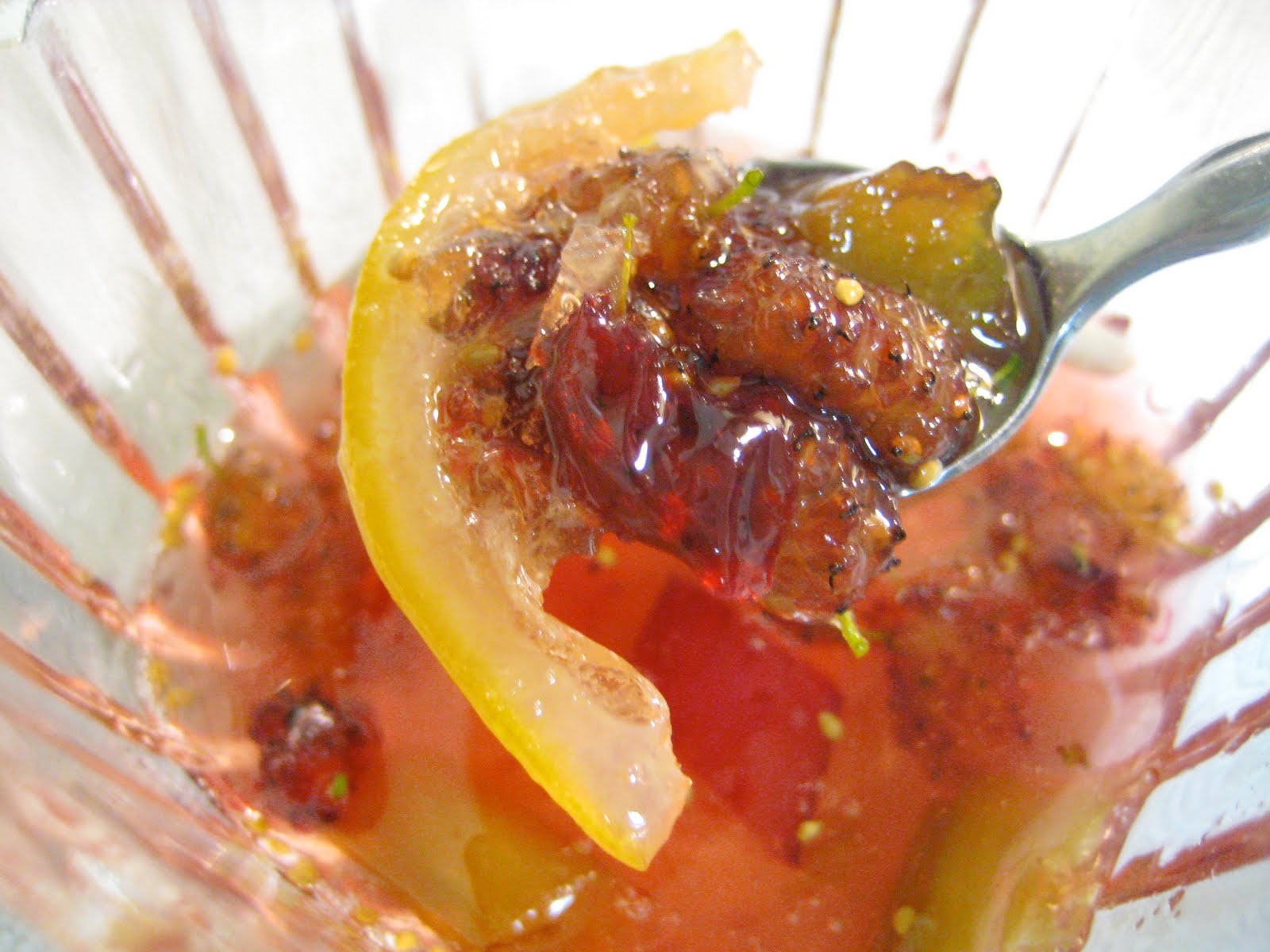
 For this month's installment of the Tigress Can Jam, the pick of the month, courtesy of the amazingly prolific and expansive Joel and Dana of Well Preserved, was berries. I can't wait for the round-up on this one. Who doesn't love berries? There are so many of them, and because this season has been incredibly early, we are rolling in them right about now. My strawberry patch stopped producing a while ago, and I thankfully caught the very end of the season at a local organic strawberry farm just the other day. I've gone across the Hudson river to pick black, red and pink currants, as my three highly productive bushes got completely cleaned out one day. (I think the culprit was a chipmunk and some birds. My fault I didn't have them netted.) Raspberries are everywhere in the wild, the small black variety and wineberries, a similar wild raspberry. The big red ones are right on their heels. And though elderberries are the size of a poppy seed, their flowers are everywhere and can make a nice syrup or liqueur. So. What do make?

A few years back, there was a small mulberry tree grappling for a space among a thatch of honeysuckle bushes. I cut back all the bushes and let the tree grow. Mulberry trees are the forgotten berry tree, even though they are everywhere and seedling pop up in cement cracks. I think people used to appreciate them more, but now they are considered just a nuisance. When I was a child, we had a large black-berried tree right next to the back door. We would spend a good portion of the summer in it. Mulberry trees are great for climbing, they have low limbs and many of them. My mother once told me a story about how mulberry tree leaves were what silk worms were fed in order to create silk. I promptly began eating the leaves, which are edible, and at the time, quite tasty. One day, my mother decided that she had had enough of the big, black berries staining the doorway, and it was cut down. I was a miserable teenager at the time, so I'm sure I pretended to not care or was outraged and indignant, one of the two---or perhaps both.
This year I was thrilled when the tree promised to have a good yield of berries. We have a white mulberry tree, which pales in comparison to the trees with black berries, both in color and taste. My son, who is almost two, and I would walk past the tree every day to let out the chickens and graze on the berries. They are mild and lack acidity, but they are sweet and free for the taking. They lasted about two weeks, and at the end they really plumped out and took on a pinkish hue. Then, suddenly the birds took over, and they declared the season over. I neglected to take a picture of them while they were hanging in the tree. Early in the morning, it's hard to remember the camera, which isn't so bad a thing really. But I now realize there isn't one good picture of the white mulberries. Can you see them floating around with the rhubarb and lemon down there in the pot?
 This jam didn't gel up too much, just like my rhubarb jam from last month, but it's incredibly delicious. I think there was a bit too much sugar in it. The taste is sweet and yet still tart, and the texture is wonderful. Strands of chewy lemon, chunks of rhubarb, and mulberries all retained their shape and became candied.
2 cups of mulberries (don't worry about those little stems, you can eat them!)
1 cup of rhubarb, diced
1 medium lemon, sliced finely
3 cups of sugar
Boil in a heavy pot until gel stage is reached, usually at around 220 degrees if you are using a thermometer. Process in boiling water for ten minutes. Makes three half-pints.

A walk down the block finds many black-berried mulberry trees, and the other day when I was looking out for a particularly good branch I had found earlier, I spied, thankfully, a large black rat snake, hanging out in the branch. Do snakes eat mulberries? Or was it just a really nice hot spot? I didn't linger to ask.
